The Problem
In 3-shift operations, there is zero tolerance for missing parts
Food & packaging is the most demanding industry for spare parts planning, because the consequences of a failure become immediately visible. Filling systems, packaging machines, and process lines run around the clock. A missing wear part doesn't just stop the machine itself, it stops the entire production of the end customer. Every hour counts.
⚠️ FDA, HACCP, and hygiene certifications require that critical spare parts are available at all times. A production stoppage caused by a missing part is not a service problem, it is a compliance risk.
Five reasons why reactive planning is particularly costly in food & packaging
-
1. Production Downtime
Immediate loss of uptime at the end customer and liability risks for the machinery manufacturer. No other industry is as directly affected.
-
2. Strict Compliance
FDA, HACCP, and hygiene regulations require seamless spare parts availability. Missing parts put the end customer's certifications at risk.
-
3. Volatile Forecasting
Production volumes in food & packaging fluctuate extremely due to seasonality, product changes, and campaign logic. Standard ERP cannot map this accurately.
-
3. High Scrap Rate
Rigid, incorrectly maintained machines produce errors. Missing parts mean not only downtime, but also quality losses.
-
5. Consignment Warehouses
Customers need local stock directly at the production site. Decentralized management without system support leads to capital tied up without any security.
Without AI-supported spare parts planning, costs of >€5 million/year arise in food & packaging according to PartsCloud analysis, the highest figure across all industries. Michael Mock, Head of Supply Chain Management at Coperion GmbH, describes the result after the transition: impending stock shortages are identified early, and planning is faster, more transparent, and data-driven.
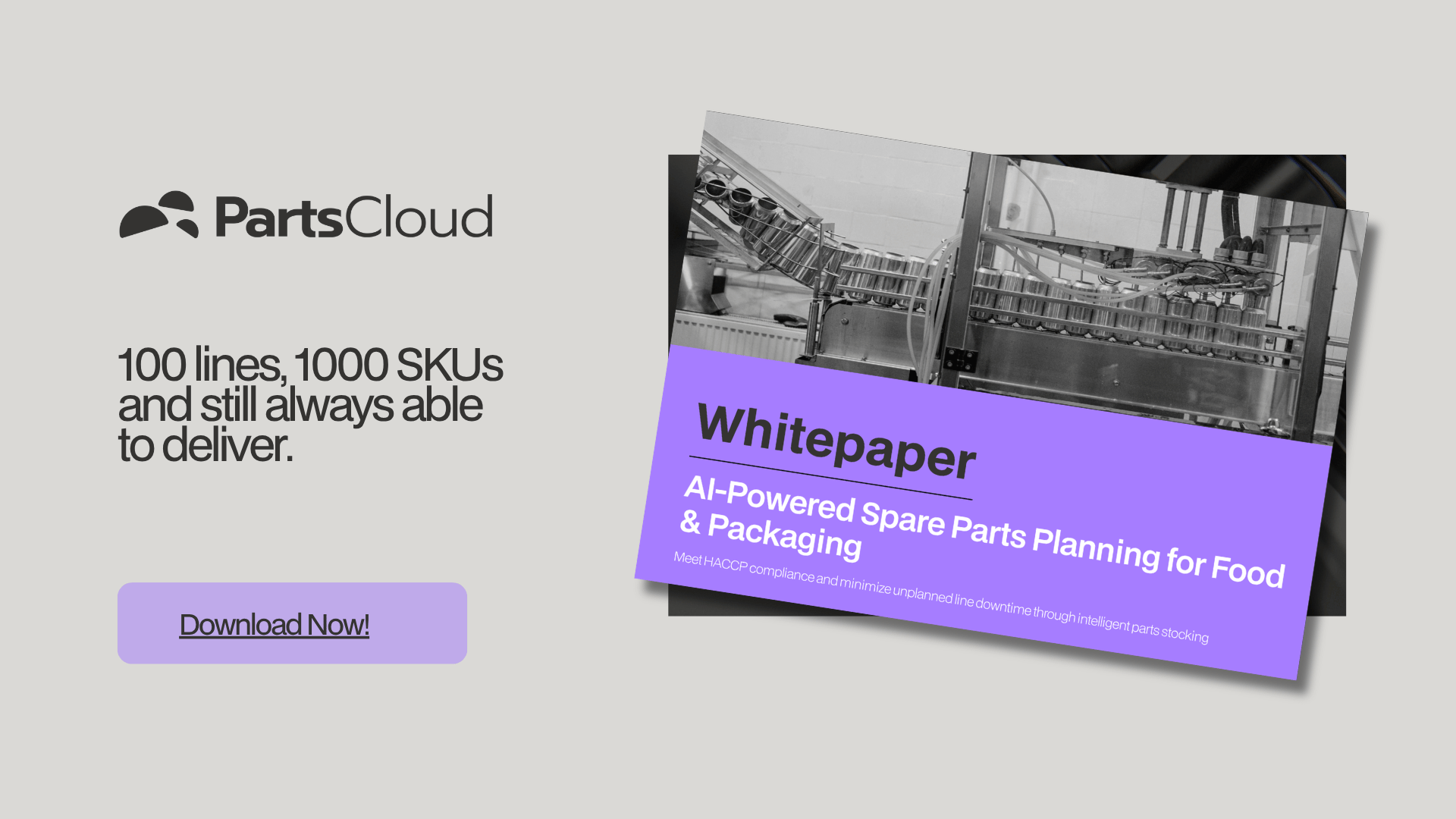
👉 Download the Full Whitepaper
Learn how food & packaging machinery manufacturers use AI-supported planning to secure 99.5% availability — with compliance, without overstocking, without an IT project.
- Why production downtime caused by missing wear parts is structurally avoidable in food & packaging
- How AI forecasts reliably map volatile demand and seasonal peaks, even across hundreds of lines and configurations
- How consignment warehouses are centrally optimized instead of being managed decentrally based on gut feeling
- What ROI companies like Coperion achieve with PartsOS, with figures and real-world examples
FAQs
-
Why is unplanned downtime particularly costly in the food & packaging industry?
A stalled filling line in three-shift operation costs more than €5M per year and simultaneously puts FDA/HACCP compliance at risk. In the food and packaging industry, every minute of downtime is a direct threat to production output, regulatory compliance, and on-time delivery to customers.
-
Why do Excel and standard ERP planning fail in packaging machinery manufacturing?
Hundreds of packaging lines, volatile production volumes, and frequent format changeovers quickly exceed the capabilities of standard ERP systems and Excel-based planning. Sporadic demand and short-notice changes lead to stockouts exactly when the line is running.
-
How does AI-powered spare parts planning ensure FDA/HACCP compliance?
AI-based demand forecasting ensures that regulatory-critical spare parts are available at all times – through automated disposition, optimized consignment stock management, and a complete data foundation for compliance documentation.
-
What results do food & packaging manufacturers achieve with AI in spare parts planning?
Manufacturers like Coperion achieve 99.5% parts availability with PartsOS Planning, reduce inventory holding costs by 20%, and eliminate unplanned downtime, while maintaining full regulatory compliance.
More Insights
Learn more case studies on industry-specific spare parts planning.
How do commercial vehicle manufacturers reduce spare parts costs with AI?
How commercial vehicle manufacturers use AI-supported spare parts planning to cut costs, centrally manage the dealer network, and prevent truck downtime, with 5–10x ROI per year and 20% less inventory.

Spare Parts Planning with AI for Semiconductor & High-Tech Production
How manufacturers of semiconductor and high-tech production equipment use AI-supported spare parts planning to secure 24/7 operations, with long lead times, highly specialized components, and a downtime risk of >€10 million per year.