
The Problem
Warehouses everywhere and still the critical parts are missing
While some commercial vehicle manufacturers are already able to guarantee their parts availability, others are still struggling with the same fundamental problem: decentralized planning across the dealer network, sporadic demand spanning 15 to 25 vehicle generations, and seasonal demand peaks that catch the system off guard every single year.
🚛 A truck standstill costs the fleet operator thousands of euros per day. The expectation is clear: the part within 24 hours. Those who fly blind don't just lose the service order, they lose the customer.
Five structural reasons why after-sales in the commercial vehicle sector ends up as a cost center and not as a profit center
-
1. After-sales runs alongside the core business
Managed as a cost center, not a profit center. Without transparency over demand and margins, there is no foundation for strategic planning.
-
2. Decentralized dealer network
Every location plans for itself, without a central forecast. The result is overstocked warehouses at the wrong locations and missing parts exactly where demand arises.
-
3. 15–25 years of vehicle generations in the field
The parts variety across all models and model years can no longer be managed with Excel. No department has a full overview anymore.
-
3. Sporadic and unpredictable demand
Harvest season, winter maintenance, and construction projects create seasonal peaks that standard ERP cannot anticipate. The same problem every year, the same missing parts every year.
-
5. Customer pressure is existential
A stationary truck costs thousands of euros per day. Customers expect the part within 24 hours. Those who cannot deliver lose the customer, to competitors or to independent dealers.
Without AI-supported spare parts planning, costs of >€3 million/year arise in the commercial vehicle sector according to PartsCloud analysis, through missing parts, truck downtime, lost service orders, and reputational damage. EUCO Rail, a reference customer from the vehicle environment, made the transition with PartsCloud from reactive Excel planning to forward-looking, data-driven spare parts planning.
👉 Download the Full Whitepaper
Learn how commercial vehicle manufacturers use AI-supported spare parts planning to cut costs, centrally manage the decentralized dealer network, and permanently prevent truck downtime.
- Why decentralized planning in the dealer network always leads to overstocked warehouses at the wrong locations and how a central AI forecast solves this
- How seasonal peaks (harvest, winter maintenance, construction projects) and 15–25 years of parts variety become plannable with AI
- How after-sales transforms from a cost center into a profit center with concrete ROI figures from ongoing customer projects
- What EUCO Rail achieves with PartsCloud: from reactive Excel planning to forward-looking spare parts logistics
More Insights
Learn more case studies on industry-specific spare parts planning.
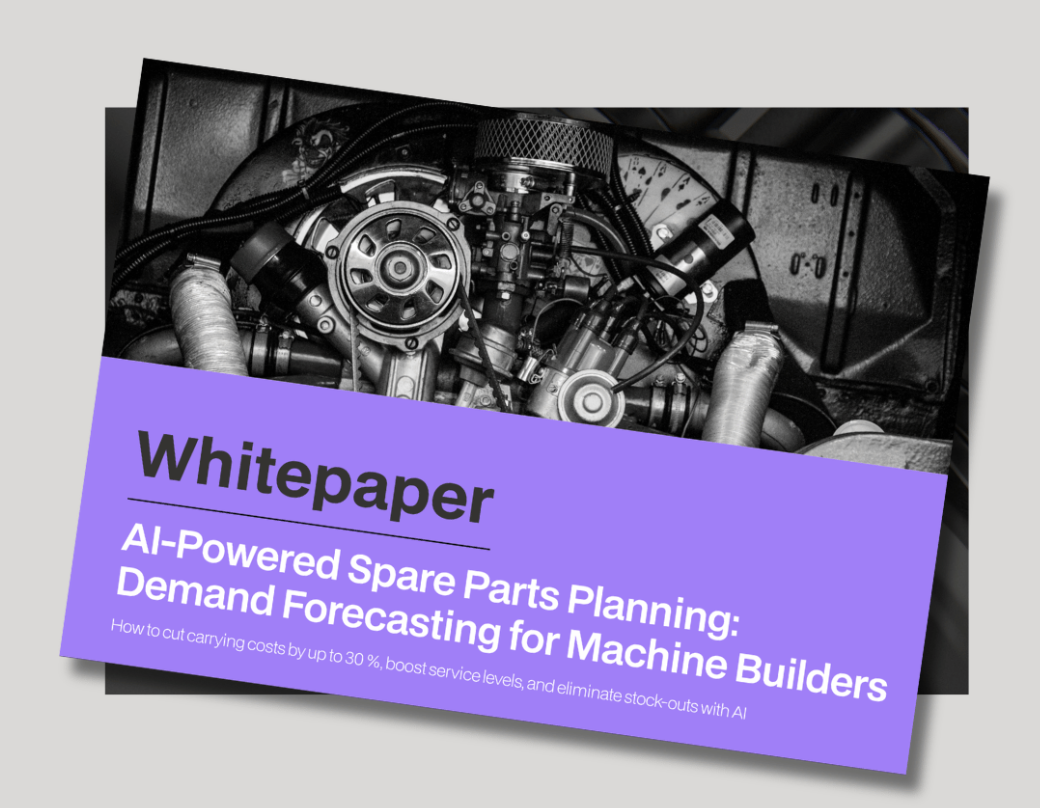
AI-Powered Spare Parts Planning For Machine Builders
How mechanical engineering manufacturers use AI-driven demand forecasting to increase spare parts availability by 15%, reduce inventory holding costs by 20%, and eliminate 90% of manual planning workload.

AI-Powered Spare Parts Planning For Semiconductor and High-Tech Production
How semiconductor and high-tech manufacturing equipment manufacturers use AI-driven spare parts planning to secure 24/7 operations, managing long lead times, highly specialized components, and an unplanned downtime risk exceeding €10M per year.
FAQs
-
What does truck downtime cost due to a missing spare part?
Every day a truck sits idle due to a missing part costs the operator over €1,000. For commercial vehicle manufacturers, this means: delivery times exceeding 24 hours directly threaten customer loyalty and the entire After-Sales business.
-
Why does decentralized Excel-based spare parts planning fail across dealer networks?
When each dealer location plans independently in Excel, there is no centralized demand picture. The result: simultaneous stockouts and overstock positions across the same network, adding up to over €3M per year in lost revenue, excess inventory, and customer churn.
-
How does AI manage spare parts complexity across 15–25 vehicle generations?
AI-driven demand forecasting makes SKU complexity manageable across multiple vehicle generations and intermittent demand patterns, through automated, centralized inventory control that considers the entire dealer network in real time and reduces inventory levels by 20%.
-
How does AI spare parts planning transform After-Sales from a cost center into a profit center?
With PartsOS Planning, commercial vehicle manufacturers leverage their After-Sales business as a strategic competitive advantage, achieving 5–10x ROI per year through lower inventory costs, higher parts availability, and stronger customer retention through reliable 24-hour delivery.